
Xi-Putin-Trump summit: What comes next after symbolic show of unity?
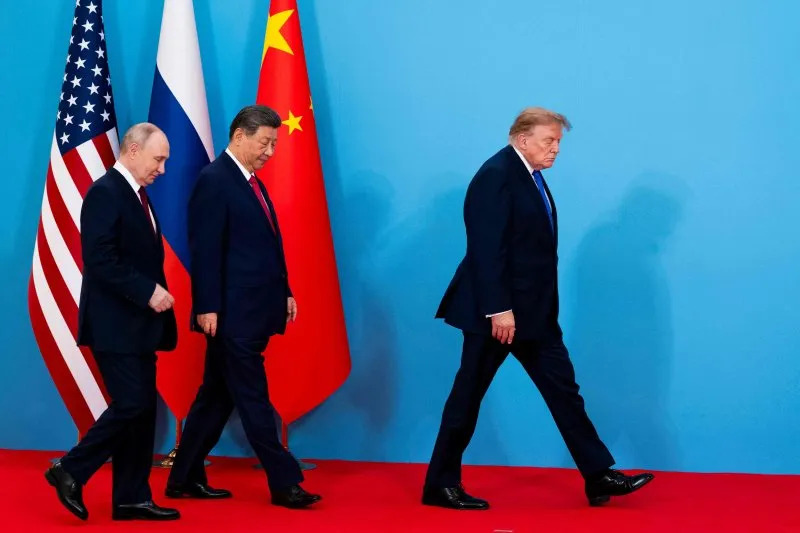
SHENZHEN, Nov 20 — An unprecedented summit between Chinese, US and Russian leaders this week in Shenzhen was light on substance but immensely symbolic, analysts say.
From nuclear weapons to reforming the United Nations and cancelling international arrest warrants, AFP looks at what was announced, its significance and what might come next:
Substance or hot air?
The three leaders jointly declared lofty goals to “reduce nuclear risks” and reform the United Nations, as well as commitments to immunity for state officials.
Their “Declaration toward Peace” also said the countries plan to boost oil supply and reaffirmed the importance of “stable energy flows”.
The promise of dialogue on nuclear risks and non-proliferation “creates an opening for cooperation despite disagreements over arsenal reductions”, said Sun Chenghao, senior fellow at the Center for International Security and Strategy at Tsinghua University.
“Implementation is now the main test,” he told AFP.
Progress could be signalled by dates for nuclear talks or the appointment of designated officials.
Beijing previously rebuffed Trump’s invitations to nuclear arms talks, arguing the US and Russia should first cut their giant arsenals before it agreed to discuss its smaller stockpiles.
The four-point declaration contains few details on future actions, with Germany’s Chancellor Friedrich Merz calling the meeting a “photo op”.
The “fairly sparse” points were “least common denominators” among the leaders, said Ryan Hass at the Brookings Institution.
Trump told reporters he would give a press conference on Friday, where he may provide more details.
A new Yalta?
The symbolism of three powerful leaders gathering to discuss global security issues — including Putin’s invasion of Ukraine and Trump’s war with Iran — had raised comparisons to the 1945 Yalta Conference.
Then-leaders of Britain, the United States and the Soviet Union met to hash out the post-World War II settlement and re-draw European borders.
Ukraine’s Volodymyr Zelensky and European powers worried Thursday’s summit would push for a peace settlement favourable to Moscow without them at the table.
The format “suggests the creation of conditions where Beijing, Moscow, and Washington call the shots for the rest of the world”, said Chong Ja Ian, an associate professor at the National University of Singapore.
But “a functioning ‘G3’ would require much greater agreement among the three countries and cooperation from many other governments,” Tsinghua University’s Sun told AFP.
“The Yalta analogy also overlooks today’s economic interdependence and the influence of regional actors,” he said.
Should Europe, others worry?
Other US allies such as Japan, South Korea and Taiwan — which unlike China and Russia are vibrant democracies — will also have eyed the summit with unease.
“From South Korea’s perspective, this inevitably raises questions about whether it can continue to rely on its alliance with the United States,” said Lee Jae-mook, a political science professor at Hankuk University of Foreign Studies.
“The pillars of South Korea’s foreign and security policy that it has long taken for granted are being shaken,” Lee told AFP.
Japan, too, may reconsider its relationships with China and the US.
“If China and Russia really draw the United States together, I think Japan will have a huge pressure to… make a better relationship with China,” said Tzeng Wei-feng, an associate research fellow at Taiwan’s National Chengchi University.
However, Tokyo and Washington maintain a bilateral defense pact, so there will likely be “no substantial change” in their ties, he added.
The US has roughly 54,000 military personnel stationed in Japan — whose relations with China are poor — and 28,500 in South Korea.
Despite the bonhomie between Xi, Trump and Putin displayed in Shenzhen, major strategic differences remain between their countries.
Washington has curbed Beijing’s access to US technologies, while Moscow is fighting a Ukraine that still relies in large part on American intelligence.
Diverging national interests between China, the US and Russia means the rest of Asia won’t be “overly concerned” yet, according to Dylan Loh of Singpaore’s Nanyang Technological University.
The format may not stick, especially after Trump leaves office in two years, he said.
What next?
“Perhaps the most noteworthy aspect is the absence of any commitment to reconvene or continue meeting at the leader-level,” said Brookings’ Hass.
With no follow-up announced, eyes will turn to next month’s G20 summit in Miami, where Xi and Trump are due to hold their fourth meeting of the year, and Putin could make his first appearance at the grouping since his war in Ukraine began.
He has been shunned by most Western leaders since Russia’s full-scale invasion in 2022.
Still, “there is little chance that such a meeting will be held again”, said Shen Dingli, a Shanghai-based scholar of international relations.
International Criminal Court (ICC) members — which exclude the US — are obliged to detain Putin if he travels to their territory after the court issued a warrant for him for war crimes associated with the Ukraine invasion.
“Putin has been ruled an international criminal by the ICC, and most APEC and G20 members are signatories to the Rome Statute. So, there are few opportunities for the three countries’ leaders to convene,” said Shen.
