
Sungai Perak blue water caused by rain, minerals and changes in water flow, state assembly told
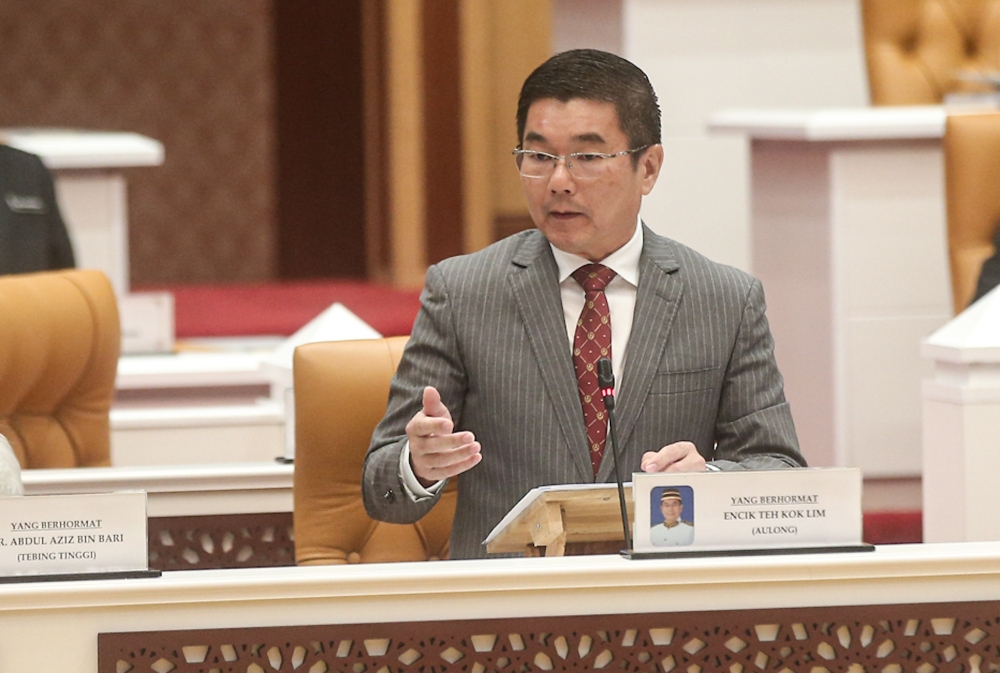
IPOH, Sept 8 — The phenomenon of Sungai Perak turning blue was caused by the interaction of several factors, including increased runoff following heavy rain, the presence of mineral particles and changes in water flow conditions, the Perak State Legislative Assembly was told today.
Perak Science, Environment and Green Technology Exco Teh Kok Lim said the finding was based on the Final Report of the Investigative Sampling (IS) Study on Sungai Rui, Gerik, conducted by experts from Scieno TW, a concessionaire appointed by the Department of Environment Malaysia.
He said the report was presented to the Perak State Executive Council on Aug 19.
“Based on the study and analysis, the experts concluded that the phenomenon was caused by the interaction of several factors, particularly increased runoff following heavy rain, the presence of mineral particles and changes in water flow conditions,” he said.
Teh was replying in writing to Kenering assemblyman Mohamad Husairi Arifin, who asked what caused the water in Sungai Perak near the Air Ganda Bridge in Hulu Perak to turn blue in early July, as well as the findings of the investigation and measures taken.
Teh said Hulu Perak was naturally rich in minerals, while heavy rainfall increased runoff, carrying more mineral particles from catchment areas, particularly open areas, into the river system.
He said data obtained by environmental scientist Dr Abd Rani Abdullah showed that rainfall during the phenomenon was almost twice as high as in the preceding period.
“This increased the volume of runoff and carried more mineral particles into the river system. However, rainfall and the presence of minerals alone were not sufficient to produce the colour-changing phenomenon.
“A certain concentration of minerals and suitable water flow conditions had to occur simultaneously,” he said.
Teh said Sungai Rui, being narrower, had a faster current, but the flow slowed when it entered the wider Sungai Perak.
“This allows fine mineral particles to remain suspended and accumulate for a longer period. When these particles interact with light, the scattering and reflection of light causes the water to appear bluish,” he said.
He said the types of minerals present, including copper, iron, aluminium and silica, as well as particle size, also influenced the optical properties and visible colour of the water.
On water quality, Teh said Sungai Perak was currently classified as Class II under the National Water Quality Index (WQI), based on an analysis of more than 30 water quality parameters.
He said the classification meant the river was suitable for uses prescribed under Class II, including recreational activities, fisheries and as a raw water source for conventional treatment before use.
Teh said the state government, through the Department of Environment (DOE), continuously carried out enforcement and inspections on premises subject to the Environmental Quality Act 1974 and its latest amendments.
“This included activities subject to Environmental Impact Assessment (EIA) requirements and industrial premises governed by the Environmental Quality (Industrial Effluent) Regulations 2009,” he said.
He said the DOE had eight manual monitoring stations and one automated monitoring station along the Sungai Perak Basin.
“Monitoring is carried out by the appointed concessionaire, while river water quality data is monitored online through the Environmental Quality Monitoring Programme.
“Manual monitoring is conducted six times a year,” he said.
Teh said any detected changes or deterioration in water quality would be notified to the DOE through the Notification of Pollution Event Level 1 or Level 2 (NPE 1/NPE 2) mechanism.
He said the early notification would allow the department to promptly identify potential pollution sources and take follow-up action.
On the way forward, Teh said the state government was considering legal, scientific and social aspects, as well as proposals from experts and residents in Hulu Perak.
Among the proposals was a Total Maximum Daily Load (TMDL) study to determine the pollution load received by Sungai Rui and Sungai Perak and to map or inventory pollution sources.
The state government also proposed establishing a state-level task force led by the Perak Water Resources Management Board to identify and coordinate action among agencies and strengthen collective enforcement.
Other proposals included studying the use of the Mine Rehabilitation Fund to rehabilitate former mining areas.
Teh said the government also planned to identify locations for installing online monitoring systems to obtain real-time data.
“Parameters including pH, dissolved oxygen, turbidity, total suspended solids and conductivity would be monitored as early indicators of abnormalities linked to mining activities,” he said.
He said the state government also planned to establish a Perak-level guideline for mining activities based on benchmarks and best mining practices adopted by leading mining countries.
“Based on these best practices, the state government can direct mining operations to be upgraded from time to time in line with the latest technology,” he said.
