
Najib: Was Maszlee’s exit triggered by his feud with YTL Communications?

PUCHONG: Former prime minister Datuk Seri Najib Tun Razak alluded that Education Minister Maszlee Malik could have been forced to quit due to his decision on the YTL-Bestarinet issue.
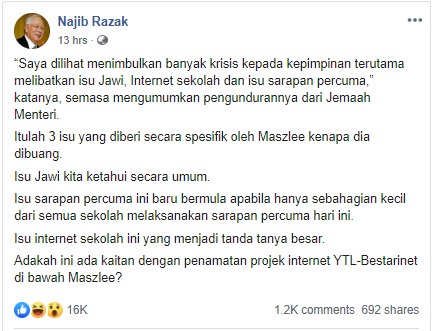
In a Facebook post yesterday, Najib said that one should decipher Maszlee’s exit speech yesterday in order to find out the real reason the Simpang Renggam MP decided to hang his boots.
“And to quote Maszlee, he said that he was seen as creating a lot of controversies to the leadership, such as on the Jawi issue, the school Internet project and the free breakfast campaign,” said Najib.
The Pekan MP said that while many aware of the Jawi issue, not much is known about the others.
“We know Maszlee received a lot of flak as only a select number of schools will be implementing the free breakfast programme which starts this year.
“But the school Internet project is the big mystery now. Was Maszlee’s resignation triggered by his ministry’s decision to end YTL-Bestarinet contract?” asked the Pekan MP.
Yesterday, Maszlee announced that he is stepping down as Education Minister, effective today, at the behest of Prime Minister Tun Dr Mahathir Mohamad.
While Mahathir had asked for some time to decide on Maszlee’s successor, some have speculated that the respected Jeli MP, Datuk Seri Mustapa Mohamed may be roped in for the post.
On July 4 last year, YTL Communications Sdn Bhd had alleged that the Education Ministry had breached its contractual obligation in regards to the supply of Internet to 10,000 schools across Malaysia.
They made the claim after Telekom Malaysia Bhd (TM), Celcom Axiata Bhd and Maxis Bhd were appointed as interim Internet services providers for the second half of last year.
Under ministry’s announcement, made on June 27, the three telecommunication companies will replace YTL Communications for the period July 1 to Dec 31, 2019.
After investing more than RM4 billion to build the infrastructure in the schools for the 15-year project, YTL Communications maintained that it was its “legitimate expectation” that it would be given an extension of the contract into the next phase.
By G Vinod
