
EU chief pitches ‘associate member’ status for Canada as bloc seeks closer cooperation
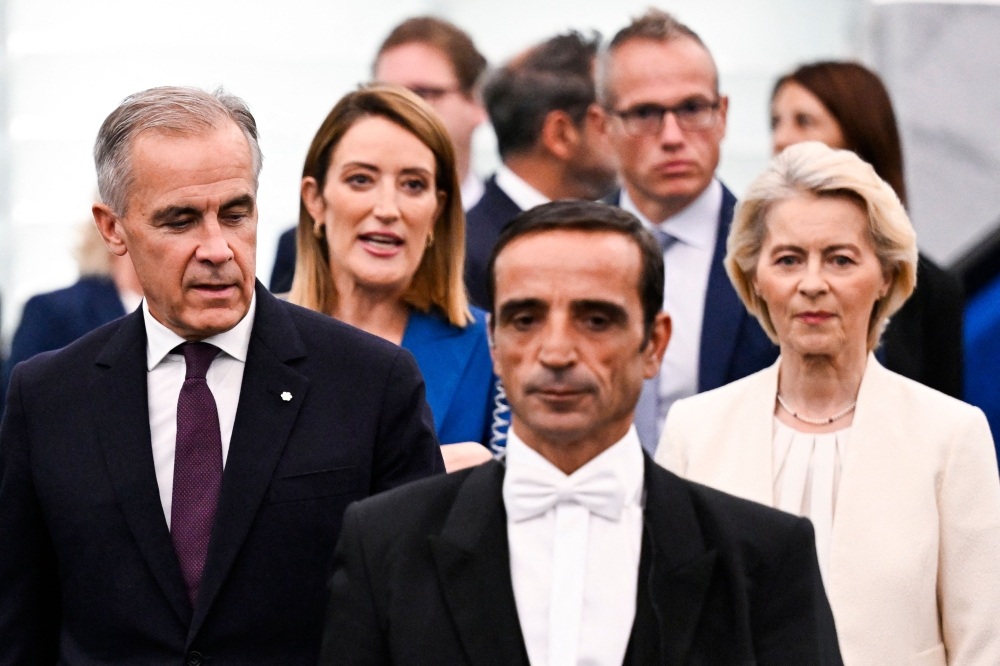
STRASBOURG, Sept 16 — EU chief Ursula von der Leyen raised the prospect today of Canada becoming the 27-nation bloc’s first “associate member’, as she pitched closer cooperation on tech, defence and energy to Canadian leader Mark Carney.
Von der Leyen told the European Parliament in Strasbourg that, as democracies face a “fracture in the international rules-based system”, Brussels and Ottawa needed to pull closer together.
“I would like to work with you on opening the door for Canada to be the first associate member of the EU,” von der Leyen told the Canadian prime minister, who was attending her annual keynote speech — drawing a standing ovation in the chamber.
Carney has been pursuing closer ties with the European Union, as both seek to pivot away from a hostile United States under President Donald Trump.
The first foreign head of government to attend the annual “State of the European Union” speech — before addressing the parliament himself the next day — his visit is meant to act as a catalyst ahead of an EU-Canada summit in Montreal next month.
Von der Leyen said it was time to move from cooperation based on trade to a broader “alliance for the future” and “bring the relationship with Canada to the highest level possible”.
“We will work on intelligent manufacturing. We will create a tech alliance. We will integrate defence industrial bases. We will make the Arctic a flagship joint project,” she said.
She listed energy, critical minerals, batteries, AI, cyber and economic security, as other fields of cooperation.
“This is a partnership not against anyone else, but for our common strength,” she added.
What’s in a name
EU treaties do not envision the possibility of becoming an “associate member”. But the idea was first floated by German Chancellor Friedrich Merz this year vis-a-vis Ukraine.
Under that plan, which met a cold reception in Kyiv as it pushes for full membership, Ukraine would have been allowed to attend the bloc’s summits and have a representative in the European Commission.
It would have also benefited from parts of the EU budget, but without full voting rights.
“We don’t really know yet what it means,” said Tobias Cremer, a centre-left European lawmaker from Germany and the main sponsor of a March resolution urging stronger EU-Canada cooperation, after von der Leyen’s “associate membership” pitch.
But a closer alliance “inherently” made sense, he added. “Not just because we share values and history but because we share common interests, we share a strategic vision,” he told AFP.
Valerie Hayer, the head of the centrist Renew group, envisaged an even broader partnership as she took the floor after von der Leyen, telling lawmakers Ottawa and Brussels must respond together to tariffs and “trade coercion”, and foster university exchanges among other things.
Others were less enthusiastic.
“Who has given you a democratic and popular mandate to do that?” Manon Aubry, a French lawmaker from the Left group asked von der Leyen.
Under EU rules, member states have to approve any form of partnership with a third country and it was unclear how much support von der Leyen’s proposal would receive from capitals.
‘Shared future’
Buffeted by US tariffs and competition from China, Brussels and Ottawa already enjoy a considerable level of cooperation.
A free-trade agreement (CETA) that abolished almost all tariffs has been credited with boosting trade in goods and services by more than 80 per cent since 2016.
And this year Canada became the first non-EU country to join a flagship defence loan programme.
On Tuesday, Canada’s ambassador to the EU Jonathan Wilkinson cited a deal to ship Canadian liquefied natural gas (LNG) to Germany, and Canadian AI firm Cohere’s investments in the same European country, as examples that could inspire broader collaboration.
Ottawa was also hoping to get over the line a deal allowing the European Investment Bank (EIB) to put money behind Canadian critical minerals projects, he told AFP.
Carney was to hold talks with von der Leyen today before flying to Britain for his first meeting with Britain’s new prime minister, Andy Burnham.
He will also attend a Premier League football match between Everton and Wolverhampton before returning to Strasbourg ahead of his Thursday speech.
“We believe that power does not belong to the strongest, the richest or the loudest — but to all of us. That democracies have the freedom to choose with whom to work,” von der Leyen said.
“We share one ocean, one set of values, one way of seeing the world. And we will now build our shared future as well,” she concluded.
