
ECRL testing shows positive results as MRL eyes December debut during school holidays
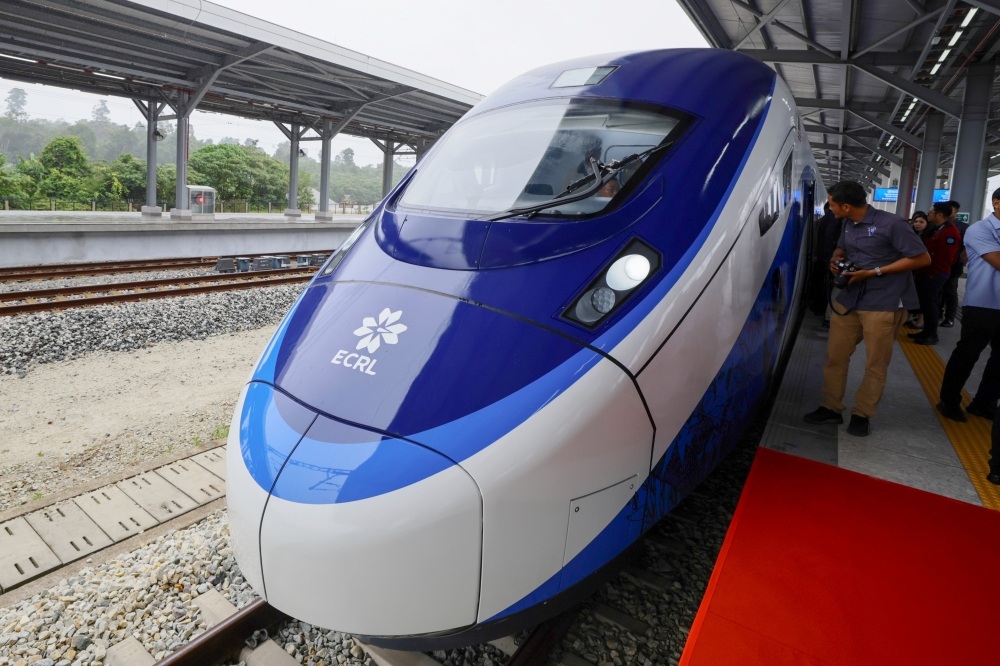
KUALA LUMPUR, Sept 18 — Malaysia Rail Link Sdn Bhd (MRL) is working towards opening the East Coast Rail Link (ECRL) to the public as early as mid-December, with testing and commissioning by its Comprehensive Inspection Train (CIT) progressing well.
MRL chief executive officer Datuk Seri Darwis Abdul Razak said positive test results had given the company confidence to meet Transport Minister Anthony Loke’s challenge to open the rail service earlier than its original January 2027 target, during the school holidays.
The CIT, known as the “yellow doctors” due to its distinctive yellow stripes and role in detecting potential issues along the railway, began testing from Kuantan to Kota Bharu last month and has now entered its second phase from Kuantan to Gombak.
“We are now in the second phase from Kuantan to Gombak, and the test results have been positive. We accept the government’s challenge to open it in December, and our efforts are focused towards that target,” he told reporters during a CIT journey from Gombak to Kuantan Port City today.
Darwis said the Site Acceptance Test (SAT) had been completed, while the System Integration Test (SIT) was about 80 per cent complete. The step-up speed test from Kuantan to Kota Bharu also recorded positive results.
Testing will continue, with the train expected to complete full runs between Kota Bharu and Gombak by the end of this month, before proceeding with the Fault-Free Run (FFR) in October.
The special CIT journey involving members of the media from Gombak to Kuantan Port City took about 90 minutes, including passage through the 16.39-kilometre Genting Tunnel at an average speed of 160 km per hour.
Darwis said MRL was continuing to work with the Kelantan, Terengganu and Pahang state governments to facilitate the targeted opening, following the ECRL project’s 95.41 per cent completion as of August. Phase 1 had reached 97.65 per cent completion.
On fares, he said no decision had been made, adding that the rate would be announced by the Transport Ministry, with the government expected to ensure it remained reasonable.
Once operational, the ECRL is expected to cut travel time between Kota Bharu and Gombak to about four hours, compared with around seven hours by road. Phase 2, linking Gombak to Port Klang, is expected to be completed by December 2027, with operations scheduled to begin in January 2028.
Meanwhile, China Communications Construction Company ECRL Sdn Bhd (CCCECRL) project director and senior advisor Kong Qi said more than 40 CIT test runs and 12 freight train tests had been completed, with results so far showing positive progress.
He said the SIT, which began on Aug 21, covered 10 key areas, including tunnels, bridges, subgrade and tracks, traction power supply, communications, passenger service information systems, electromagnetic compatibility and integrated grounding.
“We test every curve and train stability. We found some parameters that needed adjustment, such as cornering, but they have been fixed. Up to now, everything is going smoothly,” he said.
Kong said the CIT had completed speed step-up testing of up to 176 km per hour on the first section, with tests on the remaining section continuing before moving to Automatic Train Protection (ATP) and signalling tests, followed by the FFR.
The CIT is equipped with specialised inspection systems that allow engineers to evaluate track conditions, train performance and railway systems under conditions that closely simulate actual operations.
Its inspection covers track engineering, traction power supply, signalling and communication systems. The train collects data on track geometry, rail profile, wheel-rail interaction, vehicle dynamics, pantograph and catenary performance, as well as signalling and telecommunications, enabling potential issues to be identified and rectified during testing and commissioning.
As part of the SIT, the CIT conducts real-time inspections and data collection along the ECRL alignment to assess the integration of key railway systems, including signalling, communications, traction power supply and the overhead contact line.
