
Breaking News
Sultan of Pahang’s sister Tengku Aishah dies, to be laid to rest with full honours
KUANTAN, Aug 26 — The sister of the Sultan of Pahang, Tengku Puteri Seri Kemala Tengku Datuk
...Claims of armed men entering Semporna, Lahad Datu baseless
KUALA LUMPUR, Aug 16 — Claims of a group of armed men entering Semporna and Lahad
...No subsidy cuts planned despite soaring petroleum costs linked to West Asia conflict
KUALA LUMPUR, July 15 — More than 3,500 medical officers left Malaysia’s public healthcare sector over
...Melaka PKR urges calm, seeks consensus on nominated assemblymen issue
MELAKA, July 15 — Parti Keadilan Rakyat (Keadilan) Melaka has urged all parties to not make hasty
...Tunku Zain named new Tunku Panglima Besar of Negeri Sembilan
KUALA PILAH, June 10 — Yang Dipertuan Besar of Negeri Sembilan Tuanku Muhriz Tuanku Munawir today
...Politicians must watch their words, avoid misuse of free speech
KUALA LUMPUR, June 1 — His Majesty Sultan Ibrahim, King of Malaysia, today ordered all political
...
MEF Highlights and Defends Malaysia’s Labour LawReforms in Compliance with the Right to Organise and Collective Bargaining Convention, at 113th ILOConference in Geneva
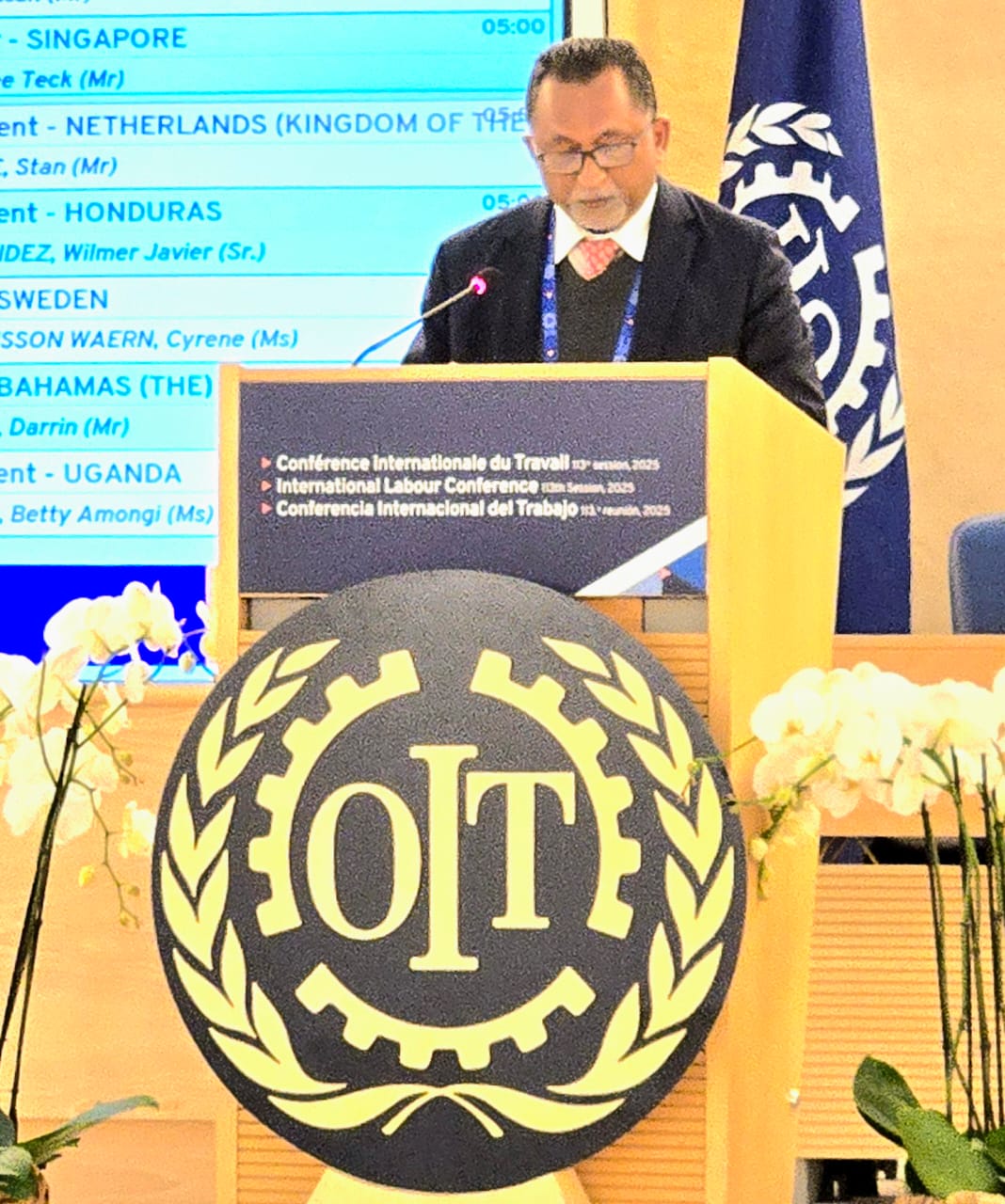
Geneva, June 10 — The Malaysian Employers Federation (MEF), delivered a
robust and reasoned intervention at the 113th Session of the International Labour Conference (ILC), Committee on Application of Standards (CAS), highlighting and defending Malaysia’s evolving industrial relations landscape and providing critical and clear clarifications on Malaysia’s compliance with
international labour standards, particularly on ILO Convention No. 98 on the Right to Organize and Collective Bargaining.
Representing Malaysian employers at the high-level Committee on the Application of Standards (CAS), MEF affirmed its full support for the progressive reforms undertaken by the Malaysian Government while addressing concerns raised by the International Labour Organization’s (ILO) Committee of Experts.
The President of MEF, Datuk Dr Syed Hussain Syed Husman, PJN, JP, states that “Malaysia is on a strong industrial relations reform trajectory. These changes must be understood in the context of Malaysia’s tripartism practices, economic structure, and operational realities. The productive industrial harmony
experienced and maintained in Malaysia are not accidental but built on a fair and functioning system,” said Datuk Dr. Syed Hussain.
Key Highlights of MEF’s Intervention:
- On Anti-Union Discrimination: MEF underscored that the DirectorGeneral of Industrial Relations (DGIR) acts not arbitrarily but with discretion, ensuring cases are filtered for merit, protecting both judicial efficiency and fairness.
- On Direct Court Access: MEF cautioned against bypassing established conciliation channels at the IR Department, highlighting that over 85% of disputes are resolved amicably at the Industrial Relations Department, proving the conciliation system’s effectiveness. The MEF highlighted that
delays in proceedings are often caused by the conduct of parties rather than systemic failures - On Union Recognition: MEF welcomed recent reforms, including secret ballots mechanism and the removal of sectoral restrictions, while rejecting unfounded claims of systemic employer interference.
“Allegations must be supported by evidence, not assumptions,” Datuk Dr. Syed Hussain asserted. - On Collective Bargaining Thresholds: MEF reaffirmed the necessity of a 50% plus one majority threshold for exclusive bargaining rights, stating that it ensures legitimacy and prevents fragmentation, particularly for SMEs.
- On the Scope of Bargaining: MEF defended the existing Section 13(3) of the Industrial Relations Act, which reasonably excludes core managerial, executive, confidential and security functions, aligning with international norms while allowing for voluntary negotiation.
- On Public Sector Bargaining: MEF highlighted Malaysia’s National Joint Council as a functioning platform yielding real outcomes, and called on the ILO to adopt a contextual, outcome based approach.
- On Bargaining Coverage: The low statistical coverage must be viewed in light of Malaysia’s SME-dominated economy. Over 300 collective agreements are signed annually, underscoring the system’s vitality
Datuk Dr. Syed Hussain emphasized the need for balanced, practical, and evidence-based reforms, urging the ILO to allow space for recent amendments, many of which took effect in September 2024, to take root before recommending further changes.
MEF’s intervention underscored Malaysia’s strong commitment to labour rights while advocating for pragmatic policies that support both workers and employers. MEF called for continued tripartite engagement and urged the ILO to recognize Malaysia’s unique economic context in future assessments.
MEF acknowledges and appreciates the continued efforts by KESUMA and the Government of Malaysia in strengthening industrial relations and supporting tripartism in the country. Over the past few years, significant legislative reforms have been undertaken, including key amendments to the Employment Act 1955, the Trade Unions Act 1959, and the Industrial Relations Act 1967. These initiatives reflect the Government’s commitment to uphold international labour standards while balancing the interests of employers, employees, and trade unions. Such progressive steps demonstrate Malaysia’s dedication to fostering harmonious and inclusive industrial relations environment.
In light of these developments, MEF strongly urges all stakeholders to fully utilize the available domestic tripartite mechanisms to address any industrial relations concerns. It is imperative that all avenues for dialogue and resolution within the national framework are exhausted before escalating matters to international platforms. This approach not only preserves the integrity of Malaysia’s tripartite system but also reinforces mutual respect, collaboration, and trust among the Government, employers, and workers’ representatives.
“Malaysia’s approach on dispute resolution is principled, pragmatic, and progressive. We are not static; we are evolving, and we invite our global partners to recognize that journey,” Datuk Dr Syed Hussain concluded.
