
Nothing off the radar: Malaysia’s army to deploy mobile CBRNE command centre in 2027 as AI upgrades its threat‑response readiness
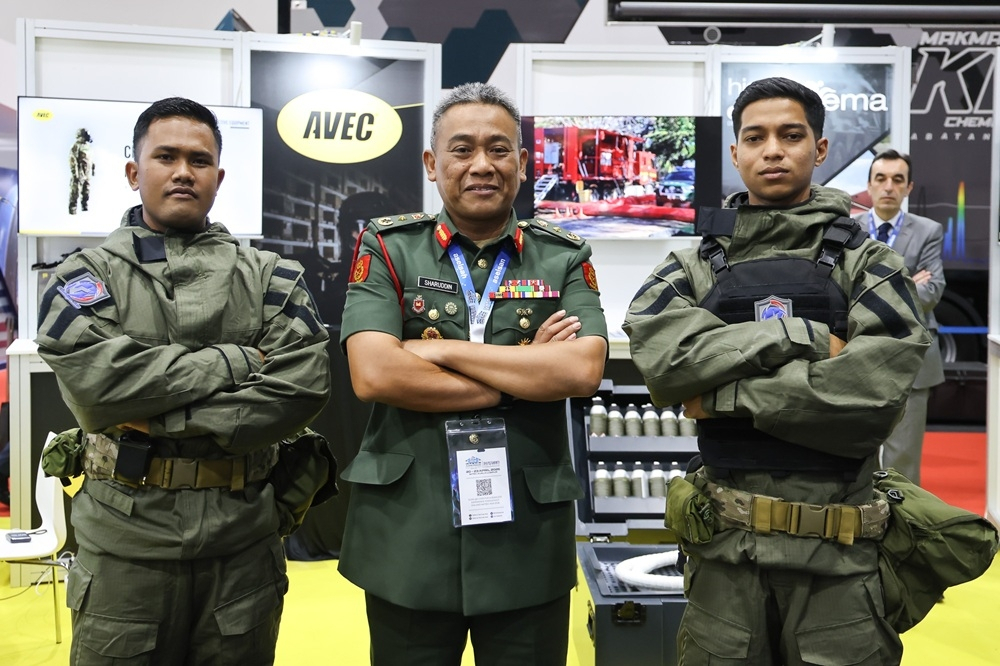
KUALA LUMPUR, April 24 — For decades, a specialised unit in the Malaysian Armed Forces (MAF) — the 12th Squadron Royal Engineer Regiment — has been quietly tracking down some of the deadliest threats on our shores.
These threats — categorised as Chemical, Biological, Radiological, Nuclear and Explosives (CBRNE) — often appear unassuming but are lethal in nature.
Now, even this subtle battleground is quietly shifting as artificial intelligence (AI) continues gaining clout.
Chief Engineer of the Royal Engineers Regiment (RAJD), Brigadier-General Sharuddin Mohd Noh said AI could potentially enhance traditional, lone-wolf plots into more sophisticated, hybrid and cyber-enabled threats.
Some possible threats, he said, include coordinated drone swarm attacks, cyberattacks on critical infrastructures or even the creation of new pathogens or toxins using AI language models.
“AI makes access to dangerous knowledge easy for malicious actors and that accelerates threat creation,” Sharuddin told Malay Mail, when met at the Defence Services Asia (DSA) and National Security (Natsec) Asia 2026 exhibition recently.
“But AI is a double-edged sword. Though it introduces severe new threats, it can also strengthen our capabilities to protect and respond,” he added.
Malaysia has rarely encountered major CBRNE breaches, barring the assassination of Kim Jong-nam with the VX nerve agent and a botched attempt to build a “dirty bomb” in 2017.
However, the country has faced several natural threats like the Nipah virus outbreak, Japanese encephalitis and the Covid‑19 pandemic.
“Malicious actors could even exploit naturally-occurring epidemics to either intentionally spread the pathogens further or to launch secondary chemical or explosive attacks.
“So, we stand prepared for all possibilities,” Sharuddin said.
Real-life threats, state-of-the-art tech
Sharuddin said MAF is slated to receive a 4×4 mobile CBRNE command centre by 2027, equipped with a state-of-the-art AI-powered threat prediction software from Finland.
The software can seamlessly detect CBRNE threats, predict the exposure radius based on meteorological conditions and roll out a response in seconds.
Currently, the CBRNE unit also has three 8×8 Armoured Engineer Nuclear, Biological, Chemical Reconnaissance Vehicles (AENBCRV) in deployment.
The vehicles, developed by Turkiye-based FNSS, are responsible for detection and surveillance of contaminated areas, meteorological data collection, sampling and hazard marking.
On the civilian front, Sharuddin said Malaysia also owns a cutting-edge mobile chemical laboratory, touted to be the most comprehensive of its kind in South-east Asia, for CBRNE response.
The chemical lab, developed in partnership with the Malaysia-based Southern Titan Group, has been operating since 2024 and is managed by the Chemistry Department.
“Some features of the lab will be integrated into our new mobile command centre, but it will be AI-powered to expedite our response,” Sharuddin said.
Besides expanding its capabilities, Sharuddin said MAF continues to build its CBRNE capabilities through annual joint trainings with foreign counterparts such as Canada.
“Under Exercise Mantis, our troops partner with the Canadian Armed Forces for a specialised training to neutralise high-risk live threats.
“Since most of these live agents are placed under the Organisation for the Prohibition of Chemical Weapons (OPCW), Malaysia uses substitutes for these agents when training locally.
“So, training with Canada provides our troops with real-life experience of dealing with actual military-grade CBRNE agents,” he explained.
Additionally, Malaysia also regularly engages in knowledge-exchange programmes with the United States and Australian Armed Forces on early detection technology and best practices to manage chemical and explosives threats in tropical climates.
Exploring drone use in recon missions
The military is also exploring the option of deploying drones for reconnaissance missions in high-risk zones, Sharuddin said.
In CBRNE operations, the area of exposure is usually classified into red, amber and green zones.
Red zones refer to the ground zero where threat is imminent while amber indicates possible contamination.
Green zones are areas declared safe for command centres and medical support to operate.
“Drones could be used for reconnaissance missions or to deploy other countermeasures in the red and amber zones. We are looking at that,” Sharuddin said.
