
Breaking News
No subsidy cuts planned despite soaring petroleum costs linked to West Asia conflict
KUALA LUMPUR, July 15 — More than 3,500 medical officers left Malaysia’s public healthcare sector over
...Melaka PKR urges calm, seeks consensus on nominated assemblymen issue
MELAKA, July 15 — Parti Keadilan Rakyat (Keadilan) Melaka has urged all parties to not make hasty
...Tunku Zain named new Tunku Panglima Besar of Negeri Sembilan
KUALA PILAH, June 10 — Yang Dipertuan Besar of Negeri Sembilan Tuanku Muhriz Tuanku Munawir today
...Politicians must watch their words, avoid misuse of free speech
KUALA LUMPUR, June 1 — His Majesty Sultan Ibrahim, King of Malaysia, today ordered all political
...Nga Kor Ming says Malaysia’s rise in trust rankings reflects growing confidence in the country
KUALA LUMPUR, May 22 — Malaysia’s ranking as the seventh most trusted nation globally under the
...Selangor Sultan calls for continued focus on rakyat’s well-being amid global crisis
KUALA LUMPUR, May 22 — The Sultan of Selangor, Sultan Sharafuddin Idris Shah, has called on
...
Act 588 amendment focuses on ‘excessive vulgarity’, serves as enforcement guide, not definitive, says Fahmi
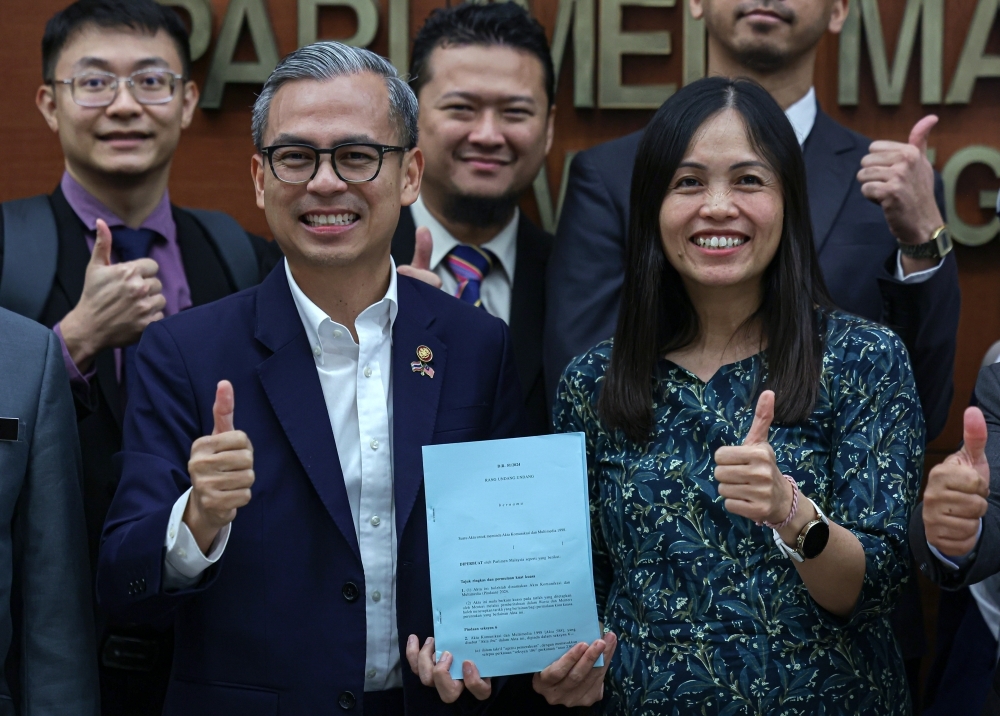
KUALA LUMPUR, Dec 17 — Elaboration of elements in the amendment to Section 233 of Act 588 (Communications and Multimedia Act 1998) including ‘grossly offensive’ is not definitive, said Communications Minister Fahmi Fadzil.
He said the explanation serves as a guide for investigating officers, prosecutors, and the courts in determining whether a particular content is deemed grossly offensive.
“The scope of offensive content has been amended to cover only ‘grossly offensive’ and not merely ‘offensive’ to differentiate content based on legal proportionality, imposing penalties or punishments appropriate to the offence’s severity.
“In this regard, ‘grossly offensive’ sets a higher threshold for offences under Section 233, taking into account expressions or actions that surpass considerations of morality, norms, and the cultural decorum of Malaysia’s harmonious society with respect to online content,” he said while tabling the Communications and Multimedia (Amendment) Bill 2024 for its second reading in the Dewan Negara yesterday.
The bill was then approved with more in favour after being debated by 21 Senators. The bill aims to address online harm, particularly on social media, by improving existing provisions, including Sections 211 and 233 of Act 588, and introducing new provisions, among other things.
Sending unsolicited commercial electronic messages such as spam, mainly related to scams, is banned under the new provision.
On calls to increase penalties, such as offences under Section 53, Fahmi said the amendment was made as a deterrent and to send a strong signal to licence holders that the government is serious about enforcing provisions regulating the communications and multimedia sector.
He said similar offences under other laws, such as the Anti-Trafficking in Persons and Anti-Smuggling of Migrants Act 2007, the Financial Services Act 2013, and the Islamic Financial Services Act 2013, carry fines between RM1 million and RM50 million and imprisonment of up to five or 10 years.
“All the details and content codes were developed without involving the Malaysian Communications and Multimedia Commission (MCMC). Instead, it was developed by the industry itself. This means that the definition, which was previously referred to as ‘offensive,’ will now be ‘grossly offensive,’ and the industry itself will also be involved in efforts to enforce this definition,” he said.
Today’s session also approved the Online Safety Bill 2024, aimed at enhancing and promoting online safety in Malaysia, after being debated by 17 Senators.
Minister in the Prime Minister’s Department (Law and Institutional Reform), Datuk Seri Azalina Othman Said, while winding up the debate on the bill, said the government drafted the bill after studying best practices from several other countries, such as the Digital Services Act 2022 of the European Union, Online Safety Act 2022 (Singapore), Youth Protection Act (Germany), Online Safety and Media Regulation Act 2022 (Ireland), Online Harms Act (Canada) dan Kids Online Safety Act (the United States of America).
According to the Online Safety Bill 2024, licensed application service providers and licensed content application service providers are responsible for implementing measures to reduce the risk of users being exposed to harmful content. They must also issue user guidelines, including terms of use, as a reference while using the service.
