
How similar will IPCMC be with Hong Kong’s IPCC?

Lately, while reviewing the Independent Police Complaints of Misconduct (IPCMC) Bill tabled in the Malaysian Parliament on 18 July, I have often recalled two things IGP Datuk Seri Hamid Bador said.
In October 2015, in his open letter to “the kleptocrat government of Najib,”, he appealed to the then IGP to move him to JIPS, the Department Integrity and Compliance to Standards. He said he wanted to serve in JIPS and drive corruption out of PDRM. This is my translation from Malay:
“I appeal to the IGP to retain me in Police Head Quarters, at least in the Department of Integrity and Compliance to Standards (JIPS) so that I can contribute positively to PDRM in matters of discipline and elimination of corruption.
On 10 May 2019, headlines screamed that Hamid had agreed to an IPCMC. Seven weeks later, on 4 July – two weeks before de facto Law Minister V K Liew tabled the IPCMC Bill in Parliament (18 July) – Hamid said to the media that he would enhance JIPS and make the IPCMC irrelevant. This is my translation:
“I will strengthen JIPS. I will put committed officers in JIPS. Under the IPCMC, the role of JIPS will not be reduced. As IGP, I consider this important. I will make the IPCMC appear irrelevant, even though it is established by law. If possible, I would like to work to make the IPCMC irrelevant because JIPS, from the beginning, has acted to strengthen the force.”
What do those two statements by Hamid tell us about how he expects JIPS and the upcoming IPCMC to work together?
After a life spent in the secretive Special Branch, will Hamid expose “dirty police secrets”?
Because of what Hamid said in his letter to Kleptocrat #1, I think Hamid is serious about cleaning up the service.
Therefore, I have a glimmer of hope that he wants JIPS and IPCC to work like the Hong Kong Police Force (HKPF) works with Hong Kong’s Independent Police Complaints Commission (IPCC).
Note: The IPCC was established in 1994 and became a statutory body on 1 June 2009. A 2017 public opinion survey of 1,010 Cantonese-speaking adult respondents found that 50% believed the IPCC was independent while 45% believed it was impartial.
The Hong Kong system is attractive because it is simple. The 2017 Annual Report of the IPCC describes it:
“Hong Kong has adopted a two-tier police complaints system. All complaints against the Police are referred to the Complaints Against Police Office (CAPO) of the Hong Kong Police Force for handling and investigation. This is the first tier of the police complaints system.
“When CAPO has completed the investigation of a Reportable Complaint, it will submit the investigation report, together with relevant files, documents and materials, to the Independent Police Complaints Council (IPCC) for scrutiny.
“If any doubt arises during its review of the investigation report and the relevant materials, the IPCC will ask CAPO for clarification or further information. If the IPCC finds the investigation inadequate, it will request that the case be further investigated.
“Only when the IPCC completely agrees that the complaint case has been properly handled will it endorse the investigation report. This is the second tier of the police complaints system.”
That’s called “vetting of cases.”
There is another oversight mechanism, the “observer system.” In the same report, the IPCC Chairman explains:
“Observers may observe the collection of evidence in connection with the Police’s investigation as set out in the Observers Scheme; the Council may also conduct interviews with case-related persons or experts to obtain information.
By educating the public about the IPCC’s principles of independence and impartiality, it is hoped that we could gain more recognition from the society. As a monitoring body, the IPCC upholds integrity, adopts an open and transparent approach, and accepts monitoring of our work by the general public, concern groups and the media.”
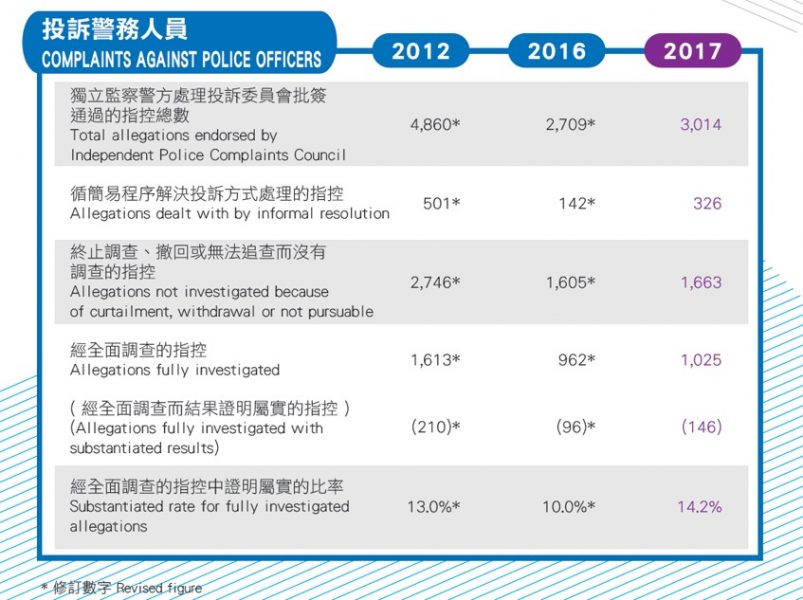
In 2017, the Hong Kong Police Force (HKPF) received 3,014 allegations against its own 39,916 personnel. That’s 77 allegations per 1,000 personnel. It “fully investigated 1,025 allegations.” All the investigations were scrutinised by the IPCC and signed off.
The HKPF publishes an annual fact sheet in which it reveals lots of information, including how many employees work in the HKPF; how many officers in each grade; numbers of cases filed, solved, etc.; budget; complaints received, processed and decisions made, etc.
Of course, the public are not entirely satisfied. They never are. But the HK cops have data they can show to prove that they take complaints seriously and that they have a public oversight system which drives continuous improvement using data from interactions with the public.
Sadly, when I read the IPCMC Bill tabled in Parliament and recall Hamid’s goal of making the IPCMC “irrelevant,” I have little more than a glimmer of hope that the Hong Kong model will be replicated in Malaysia.
By Rama Ramanathan, a member of CAGED.
The views expressed here are those of the author/contributor and do not necessarily represent the views of The Leaders Online.
